

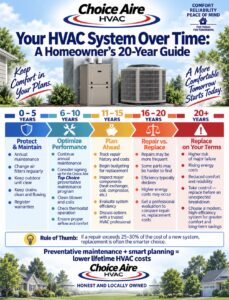
When your furnace or air conditioner stops working, one of the first questions you may face is whether it makes more sense to repair the system or replace it.
Sometimes, the answer is simple. A newer HVAC system with a minor problem may only need a straightforward repair. An older system facing a major repair may be worth replacing instead.
But many homeowners find themselves somewhere in the middle.
How old is too old for another repair? How much is too much to spend? Will a repair solve the problem, or will something else break next year? And could a newer system actually improve the comfort and efficiency of your home?
There isn’t one answer that works for every home or every HVAC system. The best decision depends on the age and condition of your equipment, the repair that’s needed, your warranty coverage, your comfort concerns, and what makes financial sense for your household.
Here are the factors Choice Aire recommends considering when deciding whether to repair or replace your heating and cooling system.
1. Start With the Age of Your HVAC System
System age is one of the first things to consider, but age alone shouldn’t determine whether you replace your equipment.
A well-maintained system may continue operating reliably for years, while a poorly maintained system may develop significant problems much sooner.
As equipment gets older, however, homeowners may begin to experience:
- More frequent repairs
- Declining efficiency
- Higher energy bills
- Uneven temperatures
- Difficulty maintaining comfortable humidity levels
- Increased noise
- More expensive component failures
If your equipment is newer and has otherwise performed reliably, repairing it will often make sense.
If it’s approaching the later years of its expected service life, a significant repair deserves a closer look before you invest more money into the system.
The question isn’t simply, “Can this system be repaired?” It’s also, “Does repairing this system make sense?”
2. Consider the Cost of the Repair
Not every repair is a reason to replace your HVAC system.
Components wear out. Parts fail. A single repair on an otherwise dependable system doesn’t necessarily indicate that the entire system is nearing the end of its life.
The decision becomes more complicated when you’re facing an expensive repair on older equipment.
Before approving a major repair, consider:
- How much will this repair cost?
- How old is the equipment?
- Has the system needed other repairs recently?
- Is the repair addressing the underlying problem or only one symptom?
- Are other major components showing signs of wear?
- How much useful life could the system reasonably have remaining?
- How does the repair investment compare with putting that money toward replacement?
A professional HVAC technician should be able to explain what failed, what it will take to repair it, and what they see when evaluating the rest of the system.
That information can help you make a decision based on the condition of your equipment, rather than relying on a generic rule.
3. Look at Your Recent Repair History
One repair and repeated repairs tell very different stories.
If you’ve had several service calls over the past few heating or cooling seasons, look at the total amount you’ve invested—not just the cost of today’s repair.
For example, repeatedly replacing individual components may keep an aging system operating, but there can come a point when continuing to invest in repairs no longer makes financial sense.
Ask yourself:
“If I make this repair today, how confident am I that this system will remain dependable?”
No HVAC contractor can guarantee that another component won’t fail in the future. However, a thorough inspection can help identify the overall condition of the equipment and whether there are other areas of concern.
4. Find Out What’s Still Under Warranty
Before making a repair-or-replace decision, determine whether the equipment or failed component is still covered by a manufacturer’s warranty.
Warranty coverage can significantly change the economics of a repair.
Depending on the equipment and warranty, a covered component may reduce your out-of-pocket repair cost. Labor and other associated costs may still apply, so it’s important to understand exactly what is and isn’t covered.
If you’re unsure about your warranty, your HVAC company may be able to help you identify the equipment information and determine what coverage applies.
5. Think About Comfort, not Just Whether the System Runs
An HVAC system can technically be “working” without keeping your home as comfortable as it should.
Consider how your home has felt over the past few years.
Are there rooms that are consistently too hot or too cold?
Does the second floor feel dramatically different from the first?
Does the system run for long periods without reaching the temperature you’ve set?
Have you noticed humidity problems?
Is the equipment unusually loud?
If you’ve been living with ongoing comfort problems, another repair may restore operation without solving those larger issues.
Replacement can provide an opportunity to evaluate the entire comfort system—including equipment sizing, airflow and the specific needs of your home—rather than simply replacing a failed component.
6. Look at Changes in Your Energy Bills
An unexpected increase in heating or cooling costs can have many causes, so a higher utility bill doesn’t automatically mean you need a new HVAC system.
Weather, utility rates, insulation, air leakage, thermostat settings, maintenance and equipment condition can all affect energy consumption.
However, if an older HVAC system is running longer and working harder to maintain the same level of comfort, declining performance may be part of the problem.
That’s another reason a professional evaluation is valuable. The goal should be to understand why your energy use has changed before assuming replacement is the answer.
7. Consider the Refrigerant Used by an Older Air Conditioner
If you’re deciding whether to make a significant repair to an older air conditioner or heat pump, refrigerant can also be part of the conversation.
HVAC refrigerants and equipment standards have changed over time. Depending on the age of your system and the refrigerant it uses, availability, service considerations and the cost of future repairs may differ from those of newer equipment.
That doesn’t automatically mean an older air conditioner needs to be replaced.
It does mean homeowners facing a major refrigerant-related repair should understand what refrigerant their system uses and how that could affect future service before making a large investment.
8. Think Beyond Today’s Repair
When your air conditioner stops working on a hot day or your furnace quits during cold weather, it’s understandable to focus on getting comfortable again as quickly as possible.
But if you’re dealing with an older system or a significant repair, it can help to think beyond today’s service call.
Consider what you want over the next several years:
- Are you planning to stay in the home?
- Would improved efficiency be valuable?
- Are there comfort problems you’d like to correct?
- Do you want greater confidence in the reliability of your equipment?
- Would you prefer to plan a replacement rather than wait for an emergency?
- Would financing make replacement more manageable?
The lowest-cost option today isn’t necessarily the lowest-cost option over time. At the same time, replacing a system that has years of reliable service remaining may not be necessary.
The goal is to understand both options.
When Does HVAC Repair Usually Make Sense?
Repair may be worth considering when:
- The system is relatively new.
- The repair is minor or reasonably priced.
- The equipment has been dependable.
- The system still keeps your home comfortable.
- The equipment is operating efficiently.
- Important components remain under warranty.
- An inspection doesn’t reveal broader concerns with the system.
When Should You Consider HVAC Replacement?
It may be worth discussing replacement when:
- The system is older and experiencing a major failure.
- Repairs are becoming frequent.
- You’ve invested significant money into the system recently.
- Major components are showing signs of wear.
- Your comfort has declined.
- The system struggles to heat or cool the home.
- Efficiency has noticeably declined.
- You’re facing a substantial repair and want to understand the cost of both options.
None of these automatically means you have to replace your system. They are signs that it’s worth comparing repair and replacement before making another large investment.
What Should Your HVAC Technician Tell You?
A repair-or-replace conversation shouldn’t feel like a sales pitch.
You should understand what’s happening with your equipment and have enough information to make your own decision.
At Choice Aire, our role is to help homeowners understand:
- What failed
- What is required to repair it
- What the repair will cost
- The approximate age and condition of the system
- Relevant warranty considerations
- Any other concerns found during the inspection
- Whether repair and replacement are both reasonable options
If replacement is worth considering, a Choice Aire technician can connect you with a comfort advisor who can take a closer look at your home, discuss your comfort priorities, and explain your equipment options.
That doesn’t obligate you to replace your system. It simply gives you the information you need to compare your choices.
Questions to Ask Before You Decide
If you’re unsure what to do, ask your technician:
- What exactly failed?
- How much will it cost to repair?
- Is the failed part under warranty?
- What condition is the rest of the system in?
- Have you noticed anything that could lead to another repair soon?
- Based on the age and condition of the equipment, is this repair reasonable?
- What would replacement involve?
- What options do I have if I want to compare the cost of repairing and replacing?
A reputable HVAC professional should be comfortable answering those questions without pressuring you toward one particular choice.
Repair or Replace? Choice Aire Can Help You Understand Your Options
When something goes wrong with your heating or cooling system, you shouldn’t have to make a major decision without understanding your options.
Choice Aire helps homeowners throughout Northeast Ohio evaluate their HVAC systems based on the condition of the equipment, the repair needed, warranty considerations, comfort concerns and their individual situation.
If a repair makes sense, we’ll explain the repair.
If your system is showing signs that replacement is worth considering, we’ll explain why and help you understand the available options.
Not sure whether you should repair or replace your HVAC system? Schedule a service visit with Choice Aire and get the information you need to make an informed decision.
Already considering a new heating or cooling system?


