

When winter hits and temperatures drop, your furnace becomes the unsung hero of your home. But for many homeowners, it’s just a “big metal box” in the basement.
Understanding how your furnace works isn’t just interesting — it helps you spot problems early, improve energy efficiency, and extend the life of your heating system.
If you’ve ever wondered how does a furnace work in Northeast Ohio during freezing winter temperatures, understanding the basics can help you protect your home and your energy bills.
In this guide, we’ll break down the essential components of a gas furnace and explain how they work together to keep your home warm and safe.
How Does a Furnace Work?
At its core, your furnace follows a simple cycle:
- Detect – The thermostat senses a drop in temperature
- Ignite – Burners create heat
- Exchange – Heat transfers safely to air
- Circulate – The blower distributes warm air through your ducts
Let’s take a closer look at each component inside your furnace and what they actually do.
The Main Parts of a Gas Furnace
1. Thermostat: The Brain of the System
The thermostat monitors the temperature inside your home.
When the temperature falls below your set point, it sends an electrical signal to your furnace to begin a heating cycle.
Modern programmable and smart thermostats improve efficiency by adjusting temperatures automatically based on your schedule.
2. Burners and Ignition System: Creating Heat
Once your furnace receives the signal:
- The gas valve opens
- The burners ignite
- Heat is generated inside the combustion chamber
Older furnaces used a standing pilot light. Newer systems rely on:
- Hot Surface Igniters (HSI)
- Electronic ignition systems
These modern systems are safer and more energy-efficient.
3. Heat Exchanger: The Safety Barrier
The heat exchanger is one of the most important components in your furnace.
It consists of metal chambers or tubes that heat up from combustion.
Its job is critical:
- Transfer heat to the air
- Keep toxic combustion gases (like carbon monoxide) separate from the air you breathe
A cracked heat exchanger can be dangerous and requires immediate professional attention.
4. Blower Motor and Fan: Moving Warm Air
Once the heat exchanger warms up, the blower motor activates.
The blower fan (often called a “squirrel cage”) pushes air across the hot heat exchanger. That heated air is then distributed through your home’s ductwork.
If your furnace runs but no warm air comes out of the vents, the blower motor may be the issue.
5. Draft Inducer Motor: Managing Exhaust Gases
Before ignition begins, the draft inducer motor turns on.
Its job is to:
- Clear leftover combustion gases
- Pull fresh oxygen into the system
- Push exhaust gases safely out through the flue
This ensures safe and efficient combustion.
6. Flame Sensor: Built-In Safety Protection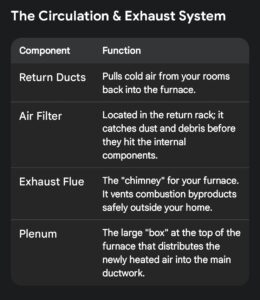
The flame sensor is a small metal rod near the burners.
Its only job is to detect whether a flame is present.
If gas flows but no flame is detected, the system immediately shuts down to prevent dangerous gas buildup.
A dirty flame sensor is one of the most common causes of furnace short-cycling.
Why Furnace Maintenance Matters
Your furnace runs through this cycle dozens of times per day during the winter.
Regular maintenance helps:
- Improve energy efficiency
- Lower heating bills
- Prevent carbon monoxide risks
- Extend system lifespan
- Reduce emergency breakdowns
One of the simplest things homeowners can do is regularly change the air filter. A clogged filter restricts airflow and strains the entire system.
When to Call a Professional HVAC Technician
Contact a licensed HVAC professional if you notice:
- Strange smells
- Loud or unusual noises
- Short-cycling (turning on and off frequently)
- Uneven heating
- Rising energy bills
Routine furnace tune-ups can prevent small issues from turning into expensive repairs.
Pro Tip:
Don’t wait until you’re experiencing problems. Preventative maintenance pays for itself — both now and in the long run. With Choice Aire’s First Choice Preventative Maintenance Program [link to request form], you’ll enjoy regularly scheduled tune-ups that ensure maximum efficiency, lower monthly energy costs, preferred pricing on replacement parts, and prioritized service when you need it most.
Stay Warm with Professional Furnace Care
Understanding your furnace is the first step in protecting your home’s comfort and safety.
If you have questions about your heating system or need professional furnace maintenance, the certified HVAC technicians at Choice Aire are here to help.
If you live in Stark County, Summit County, Medina County, or Portage County, our certified HVAC technicians are here to help with furnace maintenance, repair, and seasonal tune-ups. Choice Aire proudly serves homeowners throughout Northeast Ohio with trusted heating solutions.